
San Diego ADU Permits: Everything You Need to Know to Get Started
The Rise of ADUs in San Diego
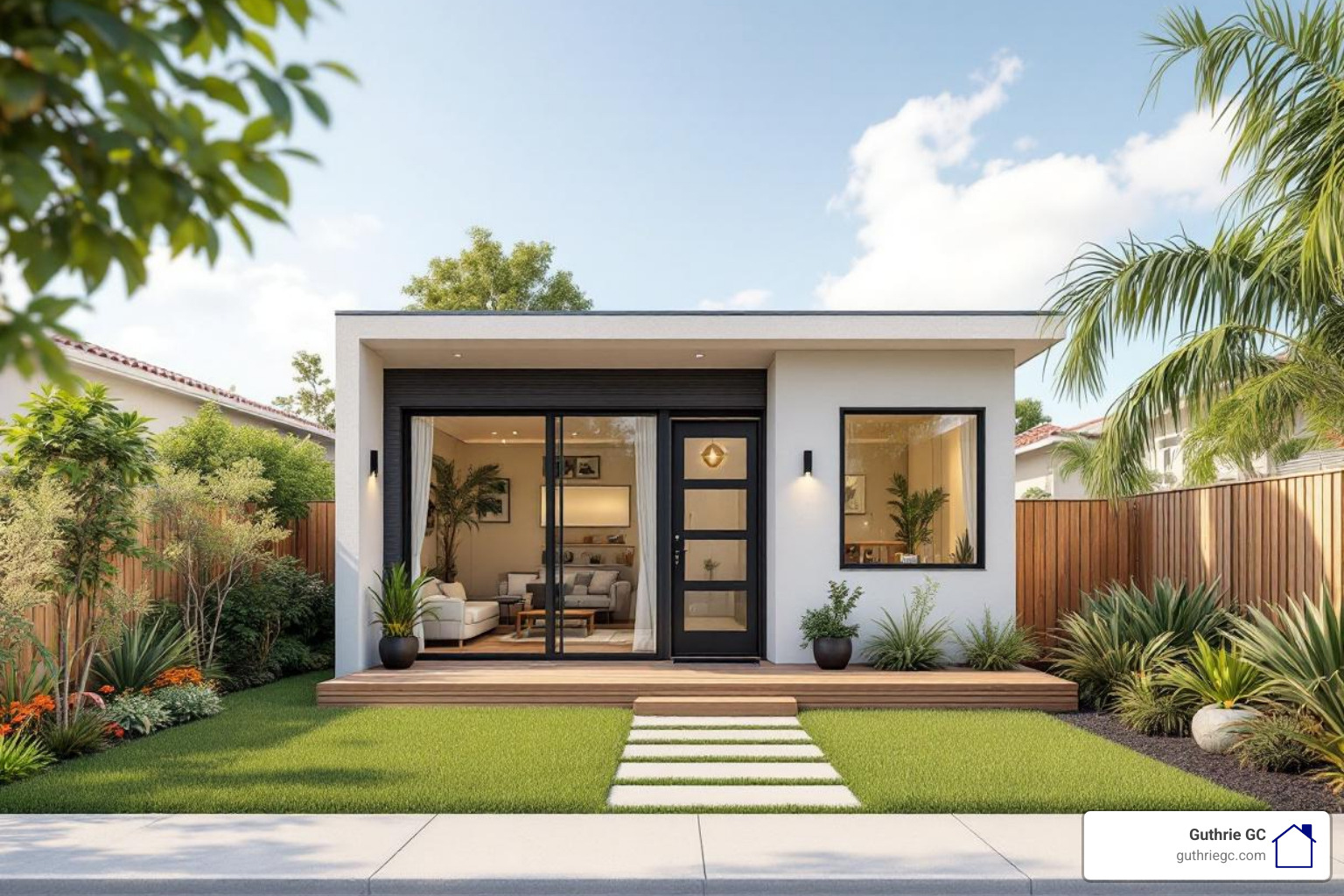
Navigating the ADU permit San Diego process can seem daunting, but it's a clear path once you know the steps. Here’s a quick overview of what you need to know:
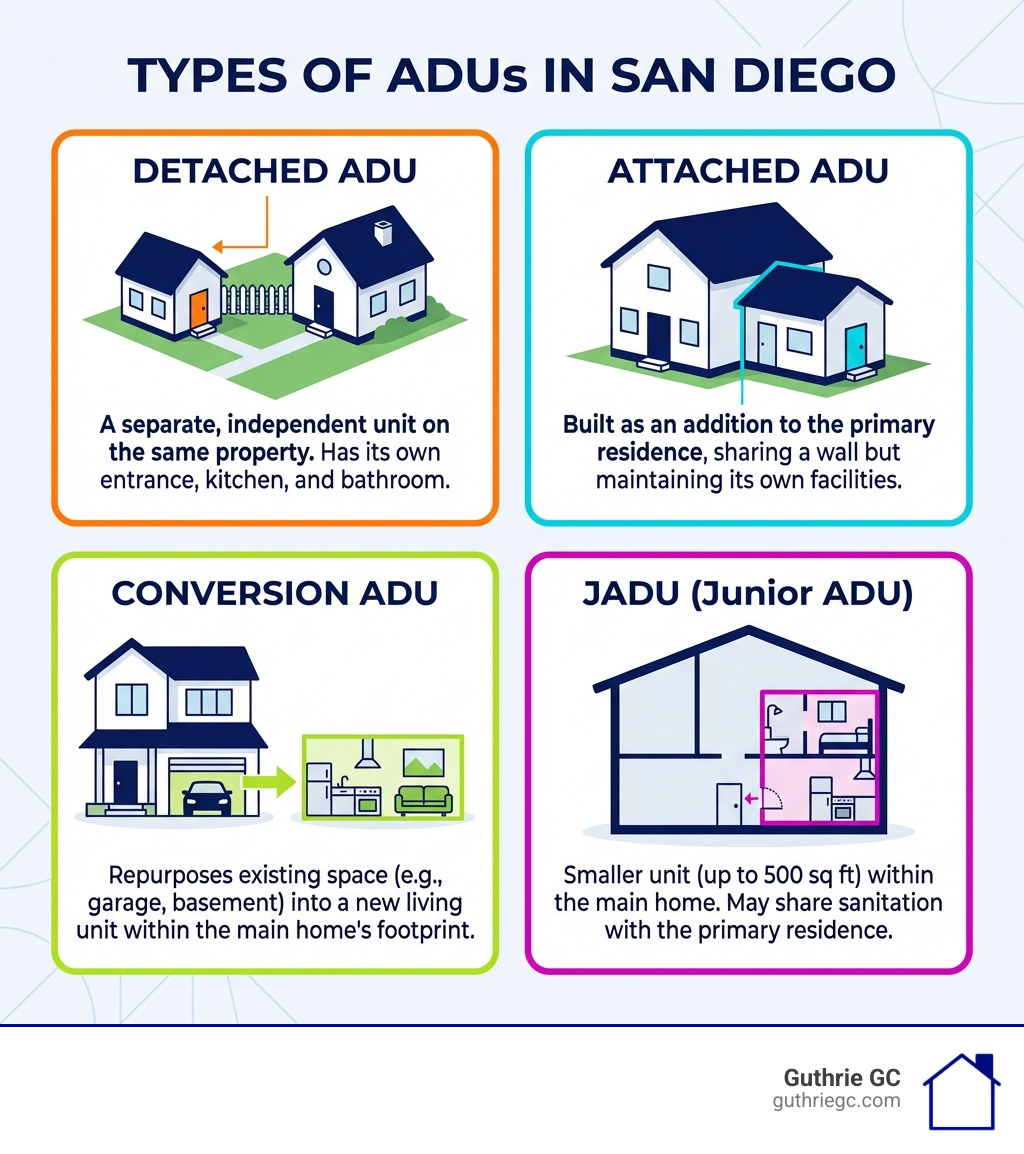
- What it is: An Accessory Dwelling Unit (ADU) is a secondary home on your property. A Junior ADU (JADU) is a smaller unit within your existing home.
- Why it matters: ADUs are vital for San Diego's housing needs. Last year, nearly 20% of new homes approved were ADUs.
- Permit Required: A permit is mandatory for any new ADU or major renovation.
- Costs: Permit costs typically range from $6,500 to $21,000, varying by size and type.
- Timeline: Straightforward projects can see approval in 2-4 months, but the average is 217 days.
- Key Regulations: You'll need to understand zoning, size limits, setbacks, and parking rules.
- Fee Waivers: State laws like SB 13 waive impact fees for ADUs under 750 sq ft.
San Diego is buzzing with ADU construction, and for good reason. The city faces a significant housing crunch, and Accessory Dwelling Units are a smart, efficient way to add more homes. These secondary units, often called granny flats or backyard homes, are changing single-family lots into versatile living spaces. They offer homeowners new income streams, flexible housing for family, or affordable rental options for the community.
But what exactly are they? An Accessory Dwelling Unit (ADU) is a separate living space on the same property as a main home. It includes a kitchen, bathroom, and sleeping area. A Junior Accessory Dwelling Unit (JADU) is smaller, typically built within the existing footprint of a single-family home or an attached garage. JADUs are usually up to 500 square feet and may share some facilities with the main house.
Gordon Guthrie, a third-generation builder and principal of Guthrie GC, has guided countless homeowners through the intricate ADU permit San Diego process. His firm specializes in high-performance residential construction, ensuring durability and regulatory compliance.
ADUs have become a cornerstone of San Diego’s housing strategy. Last year alone, 1,909 ADUs were approved for construction, making up roughly 20% of all new homes approved in the city. This highlights their critical role in addressing the city’s need for 82,000 more homes over the next five years. We at Guthrie GC believe ADUs are an important tool to help meet these housing needs and empower property owners to build for the future of their families and the community.
Understanding San Diego's ADU Rules and Eligibility
Starting on an ADU project means diving into a world of regulations. But don't worry, we're here to help you make sense of it all, whether your property is in the City of San Diego or the surrounding unincorporated areas of San Diego County like El Cajon, Escondido, or Chula Vista.
Key Regulations for an ADU Permit in San Diego
The first step in securing your ADU permit San Diego is understanding the fundamental rules that govern these units.
Zoning Requirements ADUs can be built on lots zoned for single-family or multifamily residential uses. If you have a single-family home, you can typically add one ADU and one JADU. For multifamily properties, the rules are even more flexible: you can add up to two detached ADUs, convert existing habitable space into ADUs (up to 25% of the total existing units), and convert existing non-habitable space into ADUs without limit.
To check your property's specific zoning, you can use your Assessor’s Parcel Number (APN) to run a Property Summary Report. This will tell you if your property is eligible and what specific regulations apply.
Size and Height Limitations When planning your ADU, size definitely matters.
- ADU Maximum Size: The maximum gross floor area for an attached or detached ADU in the City of San Diego is 1,200 square feet.
- JADU Maximum Size: A Junior ADU (JADU) can be a maximum of 500 square feet.
- Minimum Size: Both ADUs and JADUs must be at least 150 square feet.
For attached ADUs, the total area can be up to 50% of your primary home's total area, also capped at 1,200 square feet. We always recommend checking the Floor Area Ratio (FAR) for your specific zone, though state laws often allow ADUs to exceed this in certain circumstances.
Setback Regulations Setbacks define how close your ADU can be to your property lines. These rules vary depending on the ADU's height and your property's location:
- ADUs 16 feet or less in height: Generally, no setback is required on the rear and side yards from the property line, unless your property is in a Very High Fire Hazard Severity Zone.
- ADUs taller than 16 feet: A 4-foot setback is typically required in the side and rear yards if your property is adjacent to a residential use or located in a Very High Fire Hazard Severity Zone.
- Front Yard Setbacks: An ADU of 800 square feet or less may even encroach into the front yard or street side yard setback in some cases.
Parking Requirements Good news for most ADU projects in San Diego: parking requirements are often waived! No parking spaces are required for ADUs outside of the Coastal Overlay Zone. Even within the Coastal Overlay Zone, parking is generally not required unless the property is in the Beach Impact Area of the Parking Impact Overlay Zone and outside a Transit Priority Area. In such specific cases, one space might be required, but many exceptions apply. If you convert a garage or carport into an ADU, replacement parking is usually not required.
Special Considerations: Coastal Zone, Fire Safety, and Solar
San Diego's unique geography and commitment to sustainability introduce a few additional considerations for your ADU project.
Coastal Overlay Zone Building an ADU in areas like Coronado, Imperial Beach, or parts of La Jolla requires navigating the Coastal Overlay Zone regulations. These rules are certified by the California Coastal Commission and can include specific setback and landscape requirements. For example, Housing Action Package 1.0 introduced updated regulations that impact ADU projects in these areas. While some ADUs may require a Coastal Development Permit (CDP), recent legislation like SB 1077 / SB 1092 aims to reduce coastal development permit delays for ADUs in coastal zones.
Fire Sprinkler and Solar Photovoltaic System Requirements Safety and sustainability are paramount.
- Fire Sprinklers: If your primary dwelling unit has an automatic fire sprinkler system, your ADU will likely need one too. Additionally, the California Building Standards Code may require sprinklers based on other factors.
- Solar Panels: Newly constructed detached ADUs must comply with California Energy Code requirements for solar photovoltaic systems. This means integrating solar panels into your design, aligning with San Diego's green initiatives.
For properties located in Very High Fire Hazard Severity Zones, additional fire safety measures and potentially stricter setback requirements may apply. Our team is well-versed in designing and building resilient homes, including Earthquake Resistant Homes and those prepared for fire safety.
Breaking Down ADU Permit Costs and Fees
Understanding the financial aspect of your ADU permit San Diego is crucial. It’s not just one lump sum; it’s a collection of various fees that contribute to the overall cost.
Understanding Costs for Your ADU Permit in San Diego
The total cost for an ADU permit in San Diego can vary widely, typically ranging from about $6,500 for smaller units to $21,000 for larger, more complex projects.
Here's a breakdown of the typical fees you might encounter:
| Fee Type | Description | Typical Range (City of San Diego, 2025) |
|---|---|---|
| Plan Check Fees | Costs for reviewing your architectural and engineering plans | $1,500 - $7,500+ (depending on size/complexity) |
| Permit & Inspection Fees | Covers the building permit and subsequent inspections during construction | $1,400 - $7,800+ (depending on size) |
| School Fees | Contributes to local school districts, applies to units over 500 sq ft | $0 - $6,000+ (based on sq ft) |
| Water/Sewer Capacity Fees | Charges for connecting to or increasing capacity for water and sewer services | $1,500 - $5,000+ (City fees often for 0.5 EDU) |
| Development Impact Fees | Fees for infrastructure (parks, roads, etc.), often waived for smaller ADUs | $0 - $10,000+ (waived for <750 sq ft) |
| Other City Fees | General Plan Maintenance, Addressing, Stormwater, etc. | $500 - $2,000+ |
Note: These ranges are estimates and can fluctuate based on specific project details, current rates, and applicable waivers.
For a comprehensive list of fees, you can always refer to the City of San Diego's Fee Schedule for Construction Permits-Structures. We also recommend using the City of San Diego’s updated fee calculators to get a more accurate estimate for your specific project.
Fee Waivers, Incentives, and Key Legislation
Thankfully, state and local governments recognize the importance of ADUs and have implemented measures to reduce costs and streamline the process.
State Law Impact: SB 13 and AB 68 California has been a leader in promoting ADU construction, and several key pieces of legislation have significantly reduced financial barriers:
- SB 13 (2020): This crucial law fully waives development impact fees for ADUs under 750 square feet statewide. This can save homeowners thousands of dollars, as impact fees previously added substantial costs. Even for ADUs over 750 square feet, the fees must be proportionate to the primary dwelling. You can learn more about this through SB 13.
- AB 68 (2019): Mandated faster permit reviews (60 days) and removed certain zoning problems, making the process quicker and more predictable. Before 2019, ADU projects faced higher utility connection charges and longer approval timelines. See how AB 68 changed the landscape.
School Fees While impact fees are often waived for smaller units, school fees are a separate consideration. In the San Diego Unified School District, school fees only apply to ADUs over 500 square feet, at a rate of $5.17 per square foot (2025 rate). Always check with your local school district, as rates can vary. You can find more information from San Diego Unified.
Water and Sewer Capacity Fees These fees cover the cost of connecting to or increasing the capacity of public water and sewer systems.
- City of San Diego: For a typical 0.5 Equivalent Dwelling Unit (EDU), City fees average around $1,524 for water and $2,577 for sewer.
- San Diego County Water Authority: Separate meter fees can start at $5,859 for a <1" meter.
- Managing Costs: We advise designing your ADU with minimal fixtures to cap near 0.5 EDU. Avoiding a new separate meter unless absolutely necessary can also help you sidestep steep County capacity charges. In some qualifying projects, fee deferrals may also be available. Find out more at San Diego County Water Authority.
Navigating the ADU Permit San Diego Process
Getting your ADU permit San Diego means successfully navigating the application and review process. While it can feel like a maze, especially with the average approval time being around 217 days, there are ways to streamline your journey.
Step-by-Step Application Guide
The City of San Diego has acceptd digital tools to make the permit application process more accessible.
- Prepare Your Plans: This is where a skilled design-build contractor like Guthrie GC truly shines. We help you develop comprehensive plans that meet all local zoning, building, and fire codes. This includes site plans, floor plans, elevations, structural calculations, and energy calculations.
- Gather Required Documents: You'll need various forms, including a General Application, Water Meter Data Card, and Storm Water Applicability Checklist.
- Submit Online: Applications for ADUs and JADUs are now accepted digitally through the City's Online Permitting Account. You'll steer to the Development Services Application Portal, select "Building Construction" for new permits, and upload your documents.
- Review Cycles: Once submitted, your plans go through a review by city staff, usually within 30 days for the first round. They check for compliance with zoning, building, and other regulations.
- Corrections and Resubmission: It's common to receive comments or requests for corrections. We work with you to address these efficiently and resubmit revised plans.
- Pay Fees: Once plans are approved, you’ll pay the necessary fees.
- Inspections: After your permit is issued, construction begins, followed by various inspections at different stages to ensure everything is built to code. Our comprehensive Our Process ensures a smooth journey from concept to completion.
Timelines and How to Avoid Common Delays
While the average approval time for an ADU permit in San Diego stands at 217 days, many projects can be approved much faster. Straightforward projects, especially those utilizing pre-approved plans, can often receive permit approval in 2–4 months.
Common Delays and How to Avoid Them:
- Incomplete or Inaccurate Documentation: Missing forms, unclear drawings, or incorrect calculations are major culprits.
- Solution: Work with experienced professionals who understand the City of San Diego's requirements. Ensure all paperwork is carefully completed before submission.
- Zoning and Code Issues: Setback violations, height restrictions, or lot coverage overages can trigger extensive review delays.
- Solution: Thoroughly research your property's specific zoning and setback requirements upfront. A licensed architect or designer can ensure your plans comply from the start.
- Custom Designs: While unique designs are appealing, they often require more extensive review.
- Solution: Consider using Standard ADU Building Plans (accepted by the City of San Diego). These pre-approved designs already meet zoning laws and architectural standards, significantly cutting down review cycles. Per AB 1332, applications using pre-approved plans are subject to a 30-day review.
- Review Backlogs: Sometimes, city departments face high volumes.
- Solution: The City offers expedited options like City Express Plan Check and Rapid Review for eligible permits, potentially cutting review time by 40-50%.
The best way to prevent delays is proactive planning and thorough preparation. We also recommend familiarizing yourself with Construction Inspections Best Practices to keep your project moving smoothly after permit issuance.
Special Programs, Financing, and Future-Proofing Your ADU
San Diego offers various programs and incentives to encourage ADU development, making them more accessible and financially viable.
Bonus Programs and Financing Options
ADU Bonus Program The City of San Diego's ADU Bonus Program is a significant incentive, especially for developers and homeowners looking to add multiple units. This program allows for additional ADUs beyond the standard allowance, provided some units are deed-restricted as affordable for 15 years.
- Lot Size Caps (as of mid-2025): The City Council has capped the number of bonus ADUs based on lot size:
- Up to 4 units on lots 8,000 sqft or less
- Up to 5 units on lots 8,001-10,000 sqft
- Up to 6 units on lots over 10,000 sqft
- Affordable ADU Requirements: To qualify for bonus ADUs, you must include deed-restricted affordable units for very low-, low-, or moderate-income households. Within Transit Priority Areas (TPAs), one bonus ADU may be permitted for every affordable ADU, with no limit on the total number of ADUs. Outside of TPAs, one bonus ADU is allowed for one affordable ADU.
Financing Programs Building an ADU is an investment, and several programs can help with the costs:
- SDHC ADU Finance Program: The San Diego Housing Commission’s (SDHC) Accessory Dwelling Unit Finance Program assists low-income homeowners in the City of San Diego. It provides financial assistance in the form of construction loans and offers technical assistance throughout the process. Learn more about the SDHC ADU Finance Program.
- CalHFA ADU Grant: The California Housing Finance Agency (CalHFA) offers an ADU Grant of up to $40,000 to cover pre-construction costs. Income qualifications and funding availability vary, so it's worth checking if you qualify. You can explore this at CalHFA ADU Grant.
New Laws: Selling Your ADU and Legalizing Unpermitted Units
The legal landscape for ADUs is constantly evolving, offering homeowners more flexibility and pathways to compliance.
Selling Your ADU Separately Historically, ADUs could not be sold separately from the primary residence. However, new legislation has changed this:
- AB 1033 (2023): This law allows cities to opt-in to rules permitting ADUs to be sold separately as condominiums. This could significantly increase home equity and provide more resale options for homeowners. While not all cities have adopted this, it's a major step forward. Read more about AB 1033 (2023).
- Owner-Occupancy Requirements: Recent California ADU laws, such as AB 976 (2024), permanently remove owner-occupancy requirements for most ADUs, giving property owners more flexibility in renting their units.
Legalizing Unpermitted Units If you have an existing ADU or JADU that was built without a permit, there's a pathway to legalization:
- AB 2533 (2024): This law prohibits a local agency from denying a permit for an unpermitted ADU or JADU constructed before January 1, 2020, unless the local agency makes a finding that a substandard condition exists. This provides an important amnesty program for homeowners. We can help you understand the requirements for meeting health, safety, and building standards under AB 2533.
- SB 1226 (2018): This earlier law grants the Building Official discretion to apply building standards that were in effect at the time the unit was constructed, offering another avenue for retroactive permitting.
Legalizing an unpermitted unit ensures safety, increases property value, and open ups potential rental income. Our expertise extends to all aspects of home construction, including More info about custom home building.
Frequently Asked Questions about San Diego ADU Permits
We know you have questions, and we've gathered the most common ones to provide clear answers.
How many ADUs can I build on my property in San Diego?
This is a common question with a few nuances depending on your property type:
- Single-Family Lots: On a typical single-family residential lot, you may build one ADU (either attached or detached) and one Junior ADU (JADU). The 2025 HCD handbook clarified that you can have one single-family converted ADU, one JADU, and one detached ADU, addressing previous confusion.
- Multifamily Lots: For lots with existing multifamily residential units, you can add up to two detached ADUs. Additionally, you can convert existing habitable space into ADUs, up to 25% of the total existing unit count. An unlimited number of ADUs can be created by converting existing non-habitable space (like storage rooms or garages).
- ADU Bonus Program: As discussed earlier, the City's ADU Bonus Program can allow for even more units if you include deed-restricted affordable ADUs, with caps based on lot size (4-6 units).
For precise details, always consult 141.0302 – Separately Regulated Uses for ADUs and JADUs in the San Diego Municipal Code.
Can I use pre-approved ADU plans from another city like Encinitas or Chula Vista?
While many cities in San Diego County, including Encinitas and Chula Vista, offer pre-approved ADU plans, it's important to understand their applicability. The City of San Diego also has its own set of accepted plans.
- City-Specific Requirements: Pre-approved plans are designed to meet the specific zoning, building, and fire codes of the city that developed them. While they provide a fantastic head start, a plan from Encinitas may not automatically comply with every detail of San Diego's municipal code without adjustments.
- Portability: Some plans might be broadly compatible, but always verify with the City of San Diego Development Services Department.
- Local Code Compliance: The key is ensuring any plan, whether pre-approved or custom, fully adheres to San Diego's regulations. Using Permit Ready ADU Building Plans (accepted by the City of San Diego) or plans specifically approved for San Diego is your safest bet for a smoother process. We've worked extensively across the region, from Chula Vista to Carlsbad, and understand the nuances of each jurisdiction.
How long does it take to get an ADU permit in San Diego?
The timeline for obtaining an ADU permit San Diego can vary, but we can give you a clear picture of what to expect.
- Average Timeline: The overall permitting process in San Diego has an average approval time of 217 days. This figure includes all steps, from initial submission to final permit issuance.
- Expedited Options: For straightforward projects, especially those using pre-approved plans, approval can be much quicker, often taking 2–4 months.
- Pre-Approved Plan Advantage: Applications that use pre-approved plans are subject to a 30-day first-round review minimum. This significantly cuts down on review time compared to custom designs.
- City Express Plan Check: The City also offers programs like City Express Plan Check and Rapid Review, which can accelerate the turnaround for eligible permits.
- Factors Causing Delays: Custom designs, complex site conditions (e.g., steep slopes, historic review areas), and incomplete documentation are the most common reasons for delays. Setback violations, height restrictions, and lot coverage issues are also frequent triggers.
By leveraging pre-approved plans and working with experienced professionals, we can help you steer the process as efficiently as possible.
Start Your San Diego ADU Project with Confidence
Building an ADU in San Diego is more than just a construction project; it's an investment in your property, your family's future, and our community's housing solutions. We've walked through the essential steps, from understanding regulations and managing costs to navigating the permit process and leveraging available incentives.
The journey to an ADU permit San Diego can be complex, but with the right guidance, it becomes a clear, manageable path. At Guthrie GC, we pride ourselves on integrating sustainable, resilient building practices with transparent, client-focused service for modern Southern California living. Our three generations of expertise in custom homes, renovations, and ADUs mean we understand the local landscape, regulations, and how to deliver exceptional results.
Ready to explore the potential of an ADU on your property in San Diego, Chula Vista, Oceanside, Escondido, or any of our other service areas? Don't let the complexities deter you. Let us help you turn your vision into a reality.
Contact Us today for a consultation, and let's start building your future. You can also explore our comprehensive ADU building Services to see how we can assist you every step of the way.