Unearthing History: A Guide to Renovating Your Historic Home
Why Historic Home Renovation Demands Both Vision and Expertise
Historic home renovation is the careful process of updating older properties while preserving their original character. It requires balancing modern functionality with historical integrity, navigating specialized regulations, and working with materials and techniques specific to your home's era. A successful project involves researching your property's history, choosing between restoration or rehabilitation, assembling a team of experts, budgeting for the unexpected, and preserving character-defining features.
While older homes often present repair projects and restoration quandaries, the rewards are significant. You're not just renovating a house—you're acting as a steward of architectural heritage, preserving craftsmanship that modern construction rarely replicates. A thoughtful renovation creates a unique living space that honors the past while meeting contemporary needs.
The journey presents unique challenges, from sourcing period-appropriate materials to working with irregular structures and complying with both modern building codes and historic preservation guidelines. Remodeling can uncover a host of issues, such as water damage, dry rot, or outdated electrical systems, meaning even small projects can require more work than anticipated.
I'm Gordon Guthrie, principal of Guthrie GC, a general contracting firm in Southern California specializing in high-performance residential construction and complex renovations. Through decades of building experience, I've guided numerous historic home renovation projects that successfully integrate modern systems and sustainable materials while preserving the irreplaceable character that makes these properties special.
The Foundation: Pre-Renovation Planning and Research
Starting on a historic home renovation in Southern California is an exciting venture, but it calls for meticulous preparation. Before any work begins, a solid foundation of research and planning is crucial to respect your home's past while preparing it for the future.
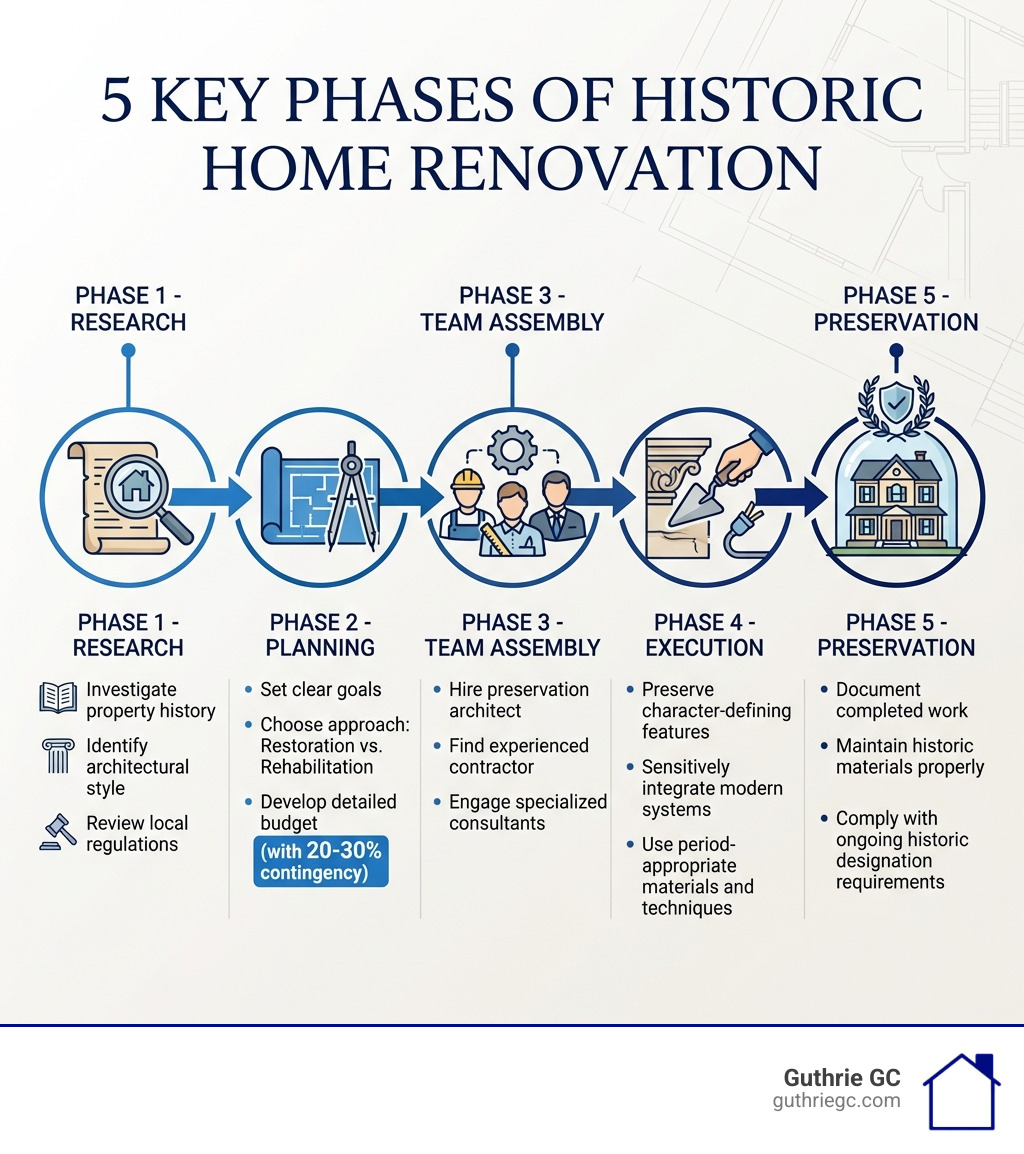
Our first step is to truly understand the property through due diligence, starting with a comprehensive inspection report. We scrutinize every element, from foundation to framework, to confirm its stability and uncover hidden issues. Next, we set clear goals: are we aiming for a strict restoration to a specific period, or a rehabilitation that adapts the home for modern living while preserving key historic features? This decision guides the entire project.
Delving into your home's history is a key part of this research. We look for original documents, check city offices in San Diego or Riverside County for permits, and explore library archives. To uncover more, you can learn how to research your home's history.
Navigating local regulations is another critical step. In areas like San Diego, Chula Vista, or Riverside, historic preservation boards have rules for both restoration and rehabilitation projects. Consulting with these local entities early is essential. For more general guidance, you can review our renovation considerations.
Understanding Your Property's Significance
Understanding your property's historical significance is paramount. A home can be considered historic for its architecture or association with notable events, not just for being on the National Register of Historic Places. Real regulatory power often lies with local bodies like the San Diego County Historical Resources Board, which may have specific conditions on updates, especially in a recognized historic district like Old Escondido.
Identifying your home's architectural style—be it a Craftsman in North Park or a Spanish Revival in Point Loma—helps us pinpoint its character-defining features. Your State Historic Preservation Officer (SHPO) is an excellent resource for guidance and professional recommendations. You can find your SHPO here.
Leveraging Community and Resources
One of the most rewarding aspects of a historic home renovation is the vibrant community surrounding it. Online forums and social media groups are a treasure trove of shared experience and advice. You can see an example from @amyleigh_1902victorian for a glimpse into this supportive world.
Local historical societies and preservation organizations, like the Old Escondido Historic District or the National Trust for Historic Preservation, are also invaluable. They offer archives, professional referrals, and educational resources. We also recommend comprehensive guides like Scott T. Hanson’s Restoring Your Historic House. You can find more about the Restoring Your Historic House book. These resources provide practical advice and foster a sense of stewardship.
The Blueprint: Restoration vs. Rehabilitation and The Secretary's Standards
Deciding the best path for your historic home means choosing between restoration and rehabilitation. This choice will fundamentally shape our approach and is often guided by the Secretary of the Interior's Standards for the Treatment of Historic Properties.
| Aspect | Restoration | Rehabilitation |
|---|---|---|
| Goal | Depict a property at a specific past period | Adapt for a compatible new use, preserving character |
| Treatment of Original Materials | Duplicate exactly, reconstruct missing from period | Repair, alter, or add new, retaining historic value |
| Approach to Modern Systems | Maintain modern systems sympathetically | Integrate modern systems for functionality |
| Historical Accuracy | Strict adherence to a chosen period | Preserve sense of changes over time |
These standards outline four official treatments: Preservation (maintaining existing materials), Rehabilitation (adapting for compatible use while preserving character), Restoration (accurately depicting a property at a specific time), and Reconstruction (recreating a non-surviving structure). Rehabilitation is the most common approach for homeowners. You can learn more about these guidelines directly from the source: The Secretary of the Interior's Standards for the Treatment of Historic Properties.
Choosing Your Approach: Restoration or Rehabilitation?
The major difference is whether we aim to exactly duplicate a period (restoration) or preserve a sense of the home's history while making it functional for today (rehabilitation).
Restoration involves returning your home to a specific appearance, which can mean reconstructing missing elements. Most homeowners opt to maintain modern systems like plumbing and HVAC even in a restoration.
Rehabilitation focuses on making the home useful for contemporary living while preserving important historic features. This approach allows for integrating modern kitchens and adapting layouts to suit modern lifestyles, provided we do so without disrupting the home's essential character.
The decision hinges on your home's history, condition, your lifestyle, and local regulations. For a deeper dive, you can explore the differences in this guide. Our goal at Guthrie GC is to balance modernization with the home's original design principles. You can also see how modern architecture differs to appreciate the unique considerations of historic structures.
Applying The Secretary of the Interior's Standards
The Secretary of the Interior's Standards for Rehabilitation are ten principles that guide us in preserving historic character. They are especially important if seeking federal tax incentives or if the project falls under local historic district regulations in San Diego or Riverside.
Key principles we follow include:
- Respecting Historic Character: We retain and preserve the distinctive materials, features, and spaces that define your property.
- Repairing vs. Replacing: Our philosophy is to repair deteriorated historic features rather than replace them. If replacement is necessary, the new component will match the old in design, color, texture, and material where possible.
- Designing Compatible Additions: New additions must not destroy historic materials, should be differentiated from the old, and be compatible in massing, size, and scale. We often recommend placing additions on rear or secondary elevations.
- Avoiding False History: We never add conjectural features or create a false sense of historical development. Authenticity is key.
These standards are a blueprint for thoughtful historic home renovation. For detailed visual examples, we refer to the Illustrated Guidelines for Rehabilitating Historic Buildings.
Assembling Your Dream Team: Finding and Working with Experts
A successful historic home renovation demands a team with specialized skills. As a design-build firm in San Diego and Riverside County, we bring together a collaborative team of architects, historians, preservation consultants, and skilled craftspeople to handle the unique challenges of older structures.

Architects specializing in historic preservation are crucial for integrating modern systems and navigating review boards. A custom millshop is another key player, able to replicate unique trim and moldings to accommodate the irregular spaces common in older homes. As your general contractor, we coordinate these specialists, ensuring a shared vision. Vetting professionals means checking portfolios for similar projects, verifying licenses and insurance, and confirming a deep understanding of preservation principles. You can learn more about our proven renovation process that ensures smooth project execution.
How to Find and Hire the Right Professionals
Finding the right experts is easier with the right resources. We recommend starting with:
- State Historic Preservation Officers (SHPOs): They can provide recommendations. Find your SHPO here.
- Local AIA Chapters: They can suggest architects experienced with historic properties. Find your local AIA chapter.
- Historical Societies: Groups like the Old Riverside Foundation are goldmines for referrals.
- Referrals: Word-of-mouth from other historic homeowners is invaluable.
Once you have a list, conduct background research on their websites. When speaking with firms, describe your project and ask for an Architect’s Qualifications Statement (B305) or Contractor’s Qualifications Statement (A305) to assess their experience. Always insist on a written contract that details the scope of work, timelines, and payment schedules. Verify the contractor has adequate insurance and obtain a signed lien waiver after final payment.
Working with Your Contractor and Architect
Once you've assembled your team, effective collaboration is key. We believe in setting transparent expectations regarding billing, services, and rates from the outset. Our design-build approach at Guthrie GC inherently fosters this integration, streamlining the process and minimizing misunderstandings.
Historic renovations are unpredictable, so we plan for extra time and build in a contingency budget to handle surprises without derailing the project. Change orders are a natural part of the process, and our clear communication ensures they are discussed and documented promptly. Finally, securing all required permits is a given, protecting you from future headaches. For more insights, check out these tips from the National Trust for Historic Preservation.
The Nuts and Bolts of a Historic Home Renovation
Once planning is complete, we dive into the intricate details of the historic home renovation. This is where we carefully bring your home back to life while preserving its soul.
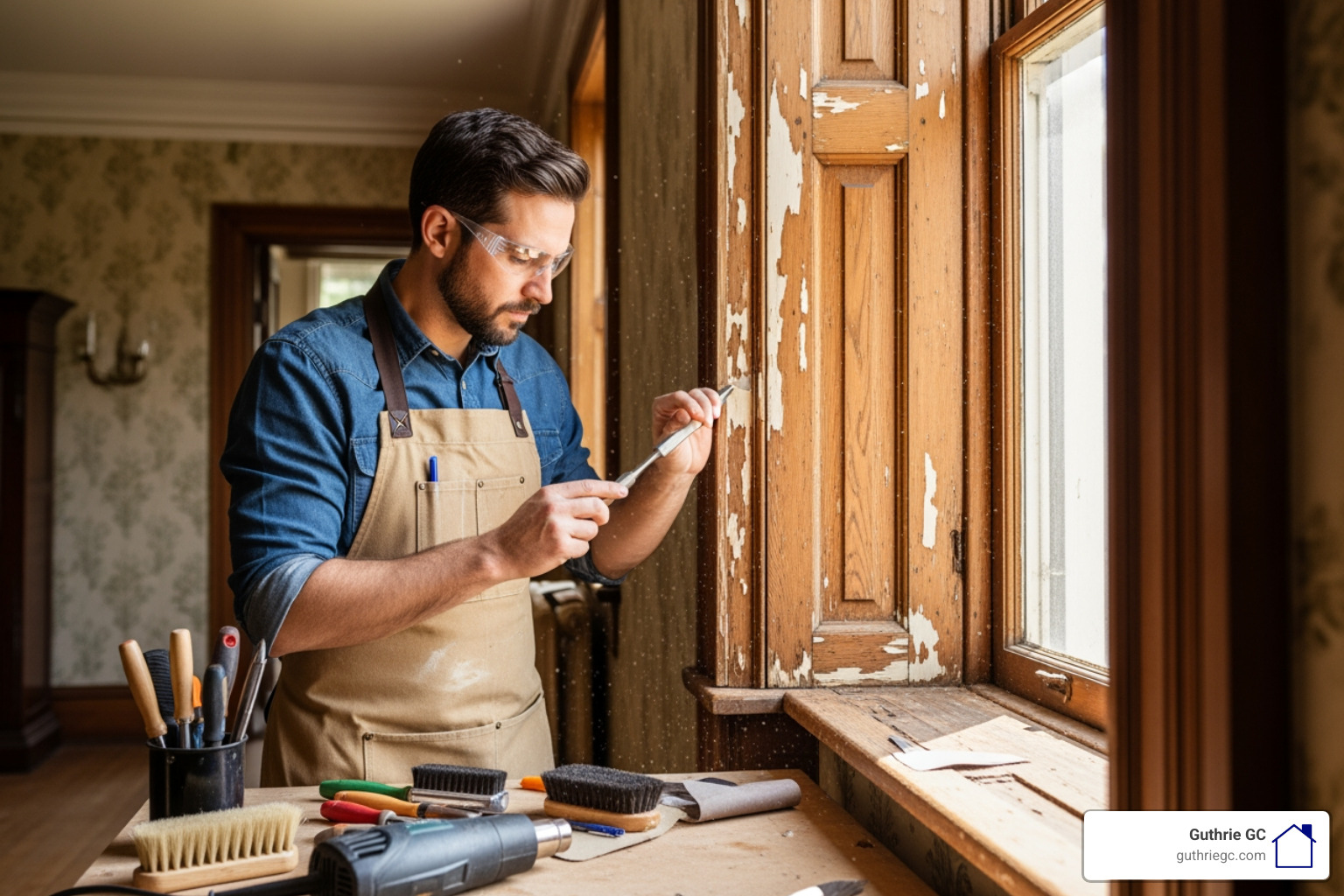
A critical first step is identifying and preserving original materials and character-defining features. We carefully assess everything before demolition, looking for details like chair rail trim and corner blocks. We believe in leaving as much original detailing as possible. Repairing plaster walls, rather than replacing them with drywall, preserves the home's charm, as does restoring original wood floors. Sourcing period-appropriate materials can be a challenge, but custom millshops can craft matching profiles for moldings to ensure authenticity. At Guthrie GC, we understand that a full house renovation requires attention to detail in every step.
Integrating Modern Systems Sensitively
Integrating modern systems into a historic home requires a delicate touch. Upgrading electrical and plumbing systems is often a top priority for safety and functionality. For HVAC, we strive to hide ductwork and units in secondary spaces like attics or basements to minimize visual impact. Upgrading insulation is also key for energy efficiency, though we approach this thoughtfully to avoid damaging historic wall structures. Our expertise extends to modern kitchens and bathrooms, where we blend contemporary function with period-appropriate aesthetics. You can explore examples of our kitchen renovation work and our bathroom renovation work.
A Practical Guide to Your Historic Home Renovation
Contrary to common belief, original wood windows are often more durable and repairable than modern replacements. We advocate for window and door restoration whenever possible, as they are character-defining features. For comprehensive advice, consider these 35 tips for restoring old houses. Repairing original hardware also contributes to authenticity. Matching historic trim is where a custom millshop becomes indispensable, creating pieces that fit the nonstandard dimensions of older homes.
Improving Accessibility and Energy Efficiency in a Historic Home Renovation
We can improve accessibility and energy efficiency without threatening a home’s character. This often involves applying universal design principles, like discreetly integrated ramps. The National Park Service offers valuable guidance on this; consult their accessibility guidelines from the National Park Service. For energy efficiency, we start with an energy audit. Historic preservation is inherently sustainable, but we can improve it by installing high-quality storm windows and integrating modern systems like high-efficiency HVAC. When considering solar panels, we carefully assess the visual impact, often opting for less visible roof planes.
Navigating Challenges, Finances, and the Renovation Process
Starting on a historic home renovation is often a journey of findy. In San Diego and Riverside County, we've seen that each home has a unique set of challenges waiting to be unearthed. Common pitfalls include starting without expert consultation, underestimating the review process for historic districts, and budgeting based on modern fixer-upper costs.
We often uncover hidden issues like water damage, dry rot, extensive electrical problems, or illegal additions. These surprises can significantly impact timelines and budgets. As Ann Cameron Siegal notes for The Washington Post, “even small restoration projects on historic homes can require much more work than anticipated.” Planning for the unexpected is a necessity. While some homeowners live on-site during a renovation, we generally recommend living off-site for significant projects to ensure safety and efficiency.
Budgeting and Financial Incentives
Budgeting for a historic home renovation requires a different mindset. The specialized labor and potential for unforeseen issues mean costs can be higher. We advise clients to budget realistically, with a contingency fund of 20-30% to cover unexpected findies. The true cost of restoring an older home is not just in money, but in the time it takes to do the project right.
Fortunately, financial incentives can help offset these costs. Homeowners may be eligible for federal, state, and local grants, tax credits, and easements. It's crucial to understand the requirements for these programs; you can learn about planning for tax incentives through the National Park Service. Investigating these options can make a historic home renovation not just an act of preservation, but also a smart long-term investment potential for your home.
Conclusion
Undertaking a historic home renovation is more than just a construction project; it's an act of stewardship, a commitment to preserving a piece of our shared heritage for future generations. The journey is undoubtedly complex, filled with unique challenges from uncovering hidden issues to navigating specialized regulations. Yet, the rewards are immeasurable: a home that tells a story, a space that blends timeless character with modern comfort, and the profound satisfaction of knowing you've contributed to the enduring beauty of our communities in San Diego and Riverside County.
At Guthrie GC, we are passionate about these projects. Our three generations of expertise in design-build construction in Southern California allow us to integrate sustainable, resilient building practices with a transparent, client-focused approach. We pride ourselves on blending modern living with the irreplaceable historical integrity of your home, ensuring that every renovation is a testament to quality craftsmanship and thoughtful preservation.
Are you ready to start on your own rewarding historic home renovation journey? We're here to guide you through every step, from initial research and planning to the final, exquisite details. Contact us to discuss your project today. If you're ready to begin your own historic home renovation in Temecula, learn more about our services in your area. Let's unearth history together.